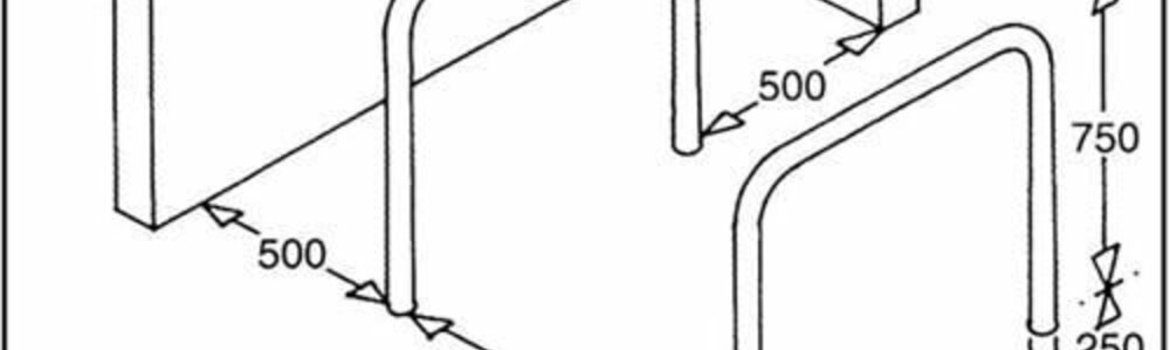
When planning bike parking, it is very important to assess the space properly. Too little space makes parking awkward for users, while too much is used inefficiently. That is why it is worth knowing the basic principles of space planning before installing bike racks.
The average bike is about 60–70 cm wide. For comfortable use, however, it is recommended to allow a little more space.
The most commonly used standards:
If several racks are installed next to each other, you need to leave enough space between them.
Recommended distances:
This makes it easy to park and remove a bike.
There are several common ways to lay out bike racks.
Racks are installed along a wall or the edge of a pavement. This is a simple, space-saving solution. Both individual U-shaped racks and multi-space racks, such as B131V-DV, work well.
Racks are installed facing each other with an aisle between them. Racks that take bikes from both sides, such as "Gyvatė" or VIRO6, also save space.
Bikes are parked at an angle. This makes more efficient use of a narrow space. Designed for this are CROSS-5, RAD5 and the rack angled at 45°.
Indoors, in basements and in underground car parks, the most bikes fit when they are hung vertically on wall-mounted holders or on the freestanding Lift Premium frame. We wrote about choosing between vertical and horizontal hanging in the article Vertical or horizontal bike holder.
In apartment block yards, bike racks are often installed along building walls or in dedicated bike areas.
It is important to ensure:
More in the article Bike racks for apartment blocks.
In cities, bike racks are most often installed near:
In such places it is important to plan for a larger number of bikes and not to forget spaces for scooters. You will find tips in the articles Bike racks for schools and Bike racks for offices and business centres, and if the racks are bought through public procurement – What to include in a bike rack technical specification.
The right bike rack layout makes the most of the available space and ensures convenient bike parking. When planning cycling infrastructure, it is important to consider the number of bikes, the width of the space and the flow of people. If you need help with planning, write to us at info@joksita.lt.
For comfortable parking, one bike needs about 70–80 cm of width, with a minimum of about 60 cm. When planning the depth, bear in mind that a bike is roughly 1.8 m long.
It is recommended to leave about 150–200 cm between rows of racks, and at least 120 cm for an access aisle.
Choose racks where bikes are parked at a 45° angle, such as CROSS-5 or RAD5, or vertical wall-mounted holders.
It depends on the model: for example, ECHO SAVE-5 is 1440 mm, CROSS-5 is 1800 mm, and the stainless steel "Mokyklinis" 5-space rack is about 200 cm long.


 Business Excellence Award 2026