We covered the general installation principles in the article Installing bike racks. Here is a practical guide by surface and specific model: how to fix a rack with nylon anchors into concrete or paving blocks, when it is worth setting it in concrete, how the concrete Loclock is installed, and what to do when there is no solid wall or base. All figures in this article are taken from our product descriptions.
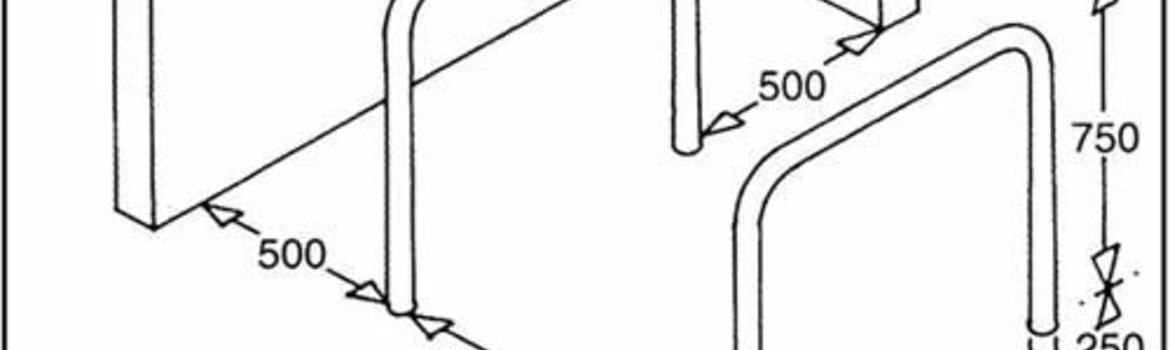
Before drilling or digging, make sure there are no cables or pipes under the surface, and measure to check that the rack with bikes in it will not obstruct the walkway.
The most common method. The rack's feet or flange are screwed to the base with nylon anchors, which are included with most models. A rack fixed this way can be moved if necessary.
| Rack | Fixings |
|---|---|
| Mini U | 6 nylon anchors Ø10×80 mm with Ø7×80 mm screws |
| U15 | 6 Ø8 mm anchors |
| CROSS-5, ECHO SAVE-5, RAD5 | 4 nylon anchors Ø10×100 mm with Ø7×107 mm screws, tightened with an SW13 or T40 key |
| VIRO6 | 4 nylon anchors Ø10×80 mm with Ø7×80 mm screws |
| Spiralė | 9 nylon anchors Ø10×80 mm with Ø7×80 mm screws |
| IKS | M12 nylon anchors |
| Tubo (bolt-down version) | Flange, 4 M10 nylon anchors – on top of the surface or under the paving blocks |
The stainless steel "Mokyklinis", "Populiarusis" and "Gyvatė" racks, the double-sided U-shaped rack and the 45° rack are also fixed to the paving with nylon anchors.
Before drilling, check the location once more: will it be easy to park bikes from the required side, will there still be a walkway, and is the rack clear of any rainwater drainage path?
On paving blocks, the most important thing is that they are stable: if a block moves, so does the rack. The Tubo flange can also be fixed under the paving blocks.
A rack set in concrete is the sturdiest and hardest to remove, so it is often chosen for public places. It is essential when the rack is placed on a lawn or in soil. Versions that can be set in concrete:
The set-in-concrete or bolt-down version must be chosen when ordering because, for example, the set-in-concrete version of Tubo has an extended frame.
The Loclock concrete bike rack, made by the Spanish manufacturer Durbanis, is fixed differently. A hole about 8–10 cm in diameter and 25 cm deep is drilled in the paving, the base of the rack is inserted into it and set in concrete. The rack weighs 15 kg and measures 450 × 60 × 735 mm. You will find all concrete models in the Concrete bike racks category.
When a room has no solid wall for holders, the Lift Premium single-sided hanging frame is a good fit: it stands on its own and holds 6 bikes hung vertically. We do not recommend installing outdoor racks without fixing them – an unfixed rack can be pushed, tipped over or carried away together with a locked bike.
One or two racks on concrete are easy to install yourself. For a larger parking area, setting in concrete or installing Loclock, it is worth ordering our installation service – we provide it throughout Lithuania; the price is 50 € incl. VAT, and for larger quantities the price is agreed separately.
The seller, UAB Joksita, which manufactures some of the racks itself, will advise you on which fixing method suits your base – call +370 614 11652. Items in stock are delivered by Venipak courier within 1–3 working days; delivery costs 9.99 € incl. VAT per order.
For most models – yes. For example, Mini U comes with 6 anchors, CROSS-5 with 4 and Spiralė with 9. Exact details are given in each product description.
Yes, if the blocks are well compacted and do not move. The Tubo flange can also be fixed under the paving blocks.
Choose a model that is set in concrete, such as Tubo, Mini U or Spiralė, or lay a small concrete or paved pad under the rack and fix it with anchors.
Loclock is not screwed down with anchors. It is inserted into a drilled hole 8–10 cm in diameter and 25 cm deep and set in concrete.


 Business Excellence Award 2026